

It’s hard to believe that Spinning is 30 years old. Yup, you read that right, Spinning was invented in the mid-1980s by ultra-marathon cyclist Johnny Goldberg (aka Johnny G) as a safe way to train indoors when the weather outside was bad—and, rumor has it, also to be able to stay close to his wife and new baby while training. In 1993, Rolling Stone magazine named Spinning the “hot” exercise of the year. Today, studios like SoulCycle can claim cult status and celebrity aficionados like Michelle Obama and David Beckham.
What about Spinning—and its generic equivalent, indoor cycling—has helped it endure for 30 years? And why is it experiencing the revival it’s going through now? Here are 10 reasons it's a great workout, and then some.
1. It’s a huge calorie burner.
Spinning can burn anywhere from 400 to 800 calories per class, which is up there with an hour of running or jogging—only you get to sit down for parts of class! It’s pretty rare to NOT see people coming out of a spin class drenched in sweat, so you know they’ve been working hard.

2. It can help build strength and not just in your legs.
3. It’s low impact and easy on your joints.
Low impact does not mean low intensity; it simply means it’s easier on your joints and reduces the risk of injury, versus something like running that is constant pounding on your joints. How many high-intensity workouts do you know of that can do that? Again, form becomes very important here, as does setting up the bike correctly to avoid knee and joint discomfort.

4. Anyone can do it, anytime. (Even when you're exhausted.)
Not only is Spinning low impact and so good for people who have a hard time with high-impact exercises, but it is also great for people of all fitness levels. Although the instructor’s job is to guide you through a challenging workout and provide a certain choreography involving speed and resistance, ultimately each rider is in control of their own pace and resistance. You always have the option of adjusting your ride to fit your needs, and if the instructor is doing a good job, they’ll motivate you to continue to push yourself.
Spinning is also a workout that it’s OK to show up tired to. Believe me, I’ve done that many times. In fact, there have been times when I’m so tired at the beginning of a workout that I’ll ride with the lights off and my eyes closed (yes, like a mini-nap). But as long as my legs are moving and the music is playing, I know that eventually I'll naturally start to wake up and increase my exertion. It happens every single time.
5. You’re alone but still in a community.
In a Spinning class, you’re riding your own bike, and chances are, once you get going, you won’t be able to talk to or even really look at anyone else. It is easy to really go inward during your ride, and many people treat it as a pseudo-meditation.
Spinning is an individual exercise: What you do on your bike has no bearing on what your neighbor does, at least directly. But each of us is doing this individual ride in a room full of other people. Everyone is there sweating it out, pushing themselves, and riding to the same music with the same instructor. If you walk into the middle of a Spin class, there is an unmistakable energy that is greater than the sum of the individuals—it’s palpable and it’s what I believe builds such a strong sense of community in class. In today’s world of iPhones and earbuds, many of us are seeking out this sense of community, whether it’s through social media or in person and sweaty!
6. It’s a major stress-reliever.
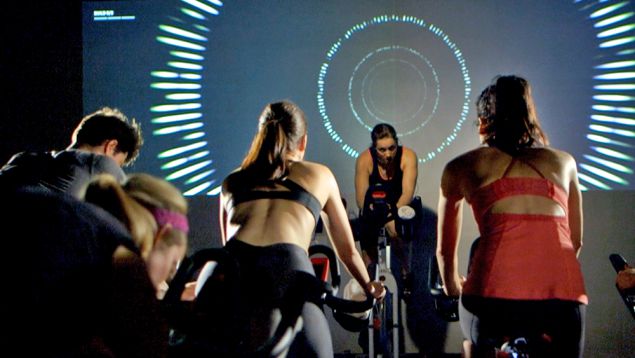
With its dark rooms and loud music, some say taking a Spin class is like going to a club. Some say it’s like a meditation. Either way, there’s something magical about a truly immersive Spin class that helps you leave your worries outside the studio doors and allows you to let go and move. In today’s busy and speedy world, so many of us are seeking out opportunities to let go and relieve stress, and Spinning is definitely a great way to do both.
Research shows that working out to fast music makes you work harder; my experience shows that without bright lights, people feel more comfortable jamming out to awesome music, and in this case that means riding your heart out.
7. It requires little skill or coordination.
The music is blaring, your heart is pumping, and you’re moving to the music, as if in a dance. But unlike a dance or Zumba class, you don’t have to be coordinated at all. You don’t have to have any skill, really. It’s a very simple movement, just pedaling in a smooth circle. All you have to do is follow the instructor’s instructions and you’re good to go!

8. You don’t have to think.
Unlike many other workouts, there aren’t any moves or steps to learn. You don’t have to be careful where you’re stepping, and you don’t have to keep track of any balls or ropes. In fact, you could completely zone out and give your brain a break for the duration of the class and you’ll be perfectly fine. Isn’t that a relief?
9. You can go really, really fast.
I love sprints. I love the feeling of letting my legs fly. In a Spin class, you can get up to 30 miles per hour! Compare that to running, where even at an eight-minute mile you're only going 7.5 mph. Where else can you generate that kind of speed without being out on the road?
10. You leave feeling uplifted and euphoric.
Most people leave Spin class on a certain kind of high. I suppose it’s a combination of all of the factors above: giving yourself that hourlong break in the day from your normal routine combined with the dark lighting, motivating music, sweating side by side with friends and strangers, all in a room that is designed to be a powerful environment for it all. What’s not to love?
Source: Jennifer Wang
http://www.mindbodygreen.com/0-25123/why-spinning-went-from-fitness-fad-to-workout-staple.html


